Tips
Invisalign vs Braces
Choosing between Invisalign and braces is not simply a question of which option looks better. For many adults, clear aligners feel more discreet and easier to imagine in daily life. Traditional braces, however, remain highly effective for many types of tooth movement and bite correction.
Written by

Clara Andersson

The right choice depends on your teeth, your bite, your treatment goals, and how consistently you can follow the plan. Some cases are well suited to clear aligners. Others are better treated with fixed braces. In more complex situations, a clinician may recommend a combined or staged approach.
At Dentra, orthodontic planning begins with diagnosis, not preference. Appearance matters, but long-term stability, function, gum health, tooth wear, and bite balance matter just as much. A good result should not only look aligned. It should also be planned carefully enough to last.
What clear aligners are best suited for
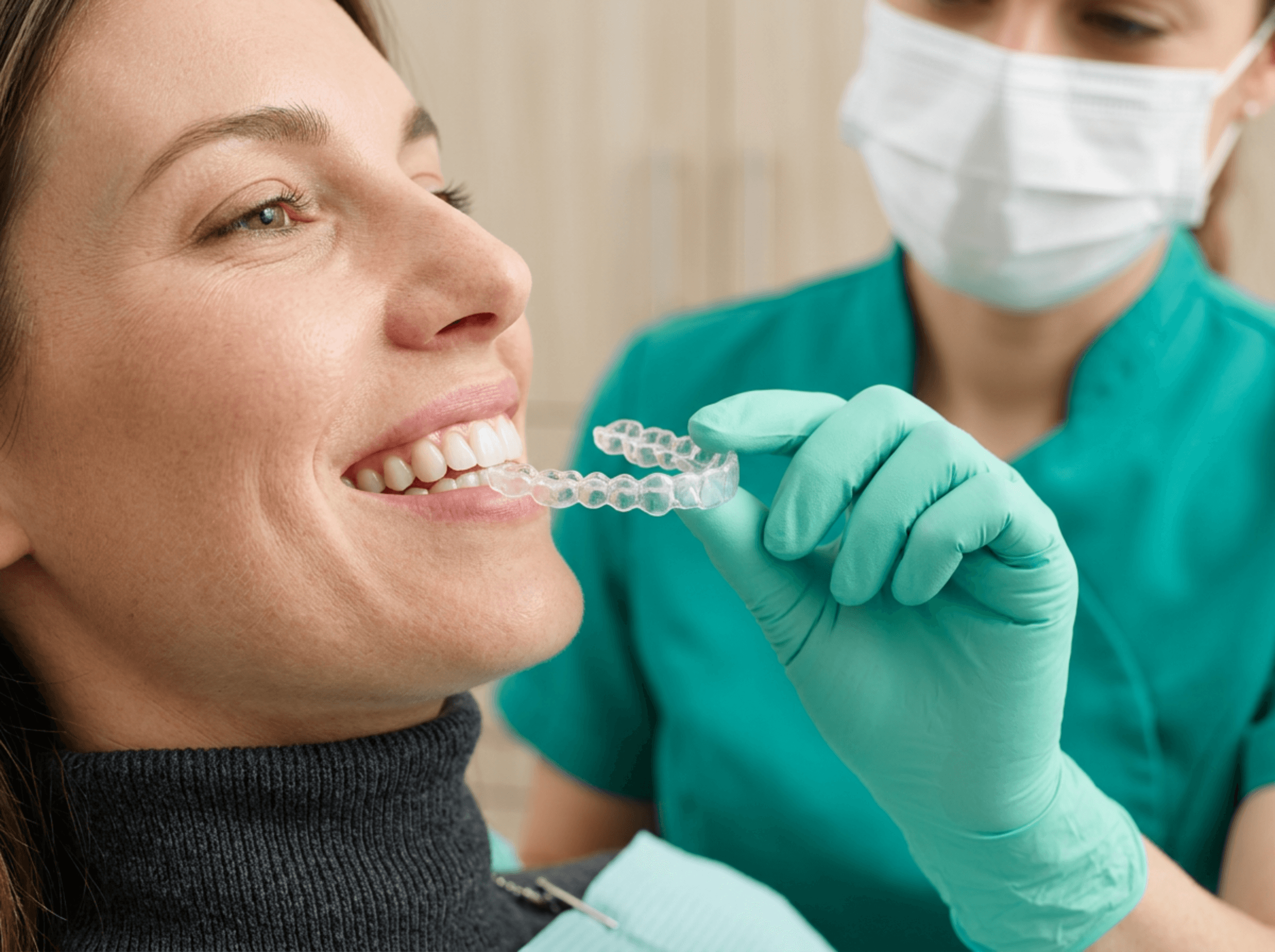
Clear aligners, often known by the brand name Invisalign, are removable transparent trays designed to move teeth gradually. They are custom-made and changed in stages as treatment progresses.
Clear aligners are often suitable for adults who have mild to moderate crowding, spacing, relapse after previous orthodontic treatment, or alignment concerns that do not require major bite correction. They can also work well when the patient wants a more discreet treatment option and is able to wear the aligners consistently.
Their main advantage is control over daily life. Aligners can be removed for eating, brushing, flossing, and important occasions. This can make oral hygiene easier compared with fixed braces. For adults with client-facing work, photography, speaking engagements, or a preference for minimal visual change, clear aligners may feel more manageable.
However, aligners only work when they are worn as prescribed. In many cases, this means around 20 to 22 hours per day, depending on the clinical plan. If they are frequently left out, tooth movement becomes less predictable. Treatment can slow down, refinements may be needed, or the result may not match the original plan.
Clear aligners are not automatically the simpler option. They require discipline, careful tracking, and regular clinical review. Attachments, small tooth-coloured shapes bonded to the teeth, may also be needed to help the aligners grip and move teeth more precisely.
What braces are best suited for
Braces are fixed orthodontic appliances. They use brackets and wires to move teeth gradually. Because they remain attached to the teeth, they do not rely on the patient remembering to wear them.
Braces are often suitable for more complex tooth movements, significant rotations, larger bite corrections, impacted or difficult-to-move teeth, and cases where predictable mechanical control is especially important. They may also be recommended when a patient is unlikely to wear removable aligners consistently.
For some adults, braces are the more clinically efficient choice. They allow the clinician to apply continuous forces and make detailed adjustments throughout treatment. This can be useful when teeth need to move in ways that are harder to achieve with removable trays alone.
Braces can be metal or ceramic. Ceramic braces are less visible than traditional metal braces, although they are still more noticeable than clear aligners. The trade-off is that braces are fixed, visible, and require more attention during eating and cleaning.
Food can catch around brackets and wires. Brushing and flossing take more time. Some foods may need to be avoided to reduce the risk of breakages. For patients with a high risk of plaque build-up or gum inflammation, oral hygiene must be considered carefully before treatment begins.
Braces are not a compromise. In many cases, they are the more precise or appropriate tool.
Comfort, appearance, and daily life
Comfort and appearance are often the first things adults compare, and understandably so. Orthodontic treatment becomes part of everyday life for months or sometimes longer.
Clear aligners are usually less visible than braces. They are smooth, removable, and do not involve brackets or wires. This can make them feel more comfortable for some patients, especially after the initial adjustment period.
That said, aligners can still cause pressure, tenderness, speech changes, and irritation. They also require routines. Every time you eat or drink anything other than water, the aligners usually need to be removed. Teeth should ideally be cleaned before the aligners are placed back in. For someone who snacks often, travels frequently, or has unpredictable workdays, this can become inconvenient.
Braces are more visible and can irritate the cheeks or lips, especially early in treatment. Wires may occasionally rub, and brackets can feel unfamiliar. But braces remove one major responsibility: they are always working. There is no need to remember to put them back in after meals.
Daily life with braces requires care around food and cleaning. Daily life with aligners requires discipline around wear time. Neither option is effortless. The better option is the one that fits both the clinical need and the patient’s real habits.
Treatment time and complexity
Treatment time varies widely. A simple alignment case may be completed relatively quickly, while a complex bite correction can take considerably longer. The appliance matters, but the biology and complexity of the case matter more.
Clear aligners can be efficient for suitable cases, especially when the required movements are predictable and the patient wears the aligners correctly. If aligners are not worn enough, treatment may take longer. Additional scans, refinements, or extra aligners may be needed.
Braces may be more suitable when teeth need stronger control or when movements are difficult to achieve predictably with aligners. In some complex cases, braces may offer better control from the beginning, rather than attempting a treatment plan that later needs significant correction.
It is not accurate to say that Invisalign is always faster. It is also not accurate to say braces are always more reliable. Treatment time depends on diagnosis, treatment goals, tooth movement, bone response, bite correction, oral health, and patient cooperation.
A premium orthodontic plan should not be built around speed alone. Moving teeth too quickly or without proper planning can increase the risk of instability, gum problems, root concerns, or a result that looks straight but functions poorly.
Why bite planning matters
Many patients think orthodontics is mainly about straight teeth. Alignment is important, but bite planning is often the difference between a cosmetic improvement and a clinically sound result.
The bite determines how upper and lower teeth meet. If the bite is not planned carefully, teeth may look straighter but still place excessive pressure on certain areas. This can contribute to wear, chipping, gum recession, jaw discomfort, or relapse.
Bite planning is especially important for adults because the teeth, gums, bone levels, restorations, and previous dental work may all influence the treatment plan. Crowns, implants, veneers, missing teeth, worn edges, and gum recession can change what is possible or advisable.
Clear aligners can correct many bite issues in suitable cases, but they have limits. Braces can also correct many bite issues, but they must still be planned carefully. The question is not which system is fashionable. The question is which system gives the clinician the right level of control for your diagnosis.
At Dentra, the bite is assessed before recommending an appliance. The aim is not only to improve the smile, but to protect the long-term function of the teeth.
Cost and long-term maintenance
Cost depends on case complexity, treatment length, appliance type, planning requirements, review appointments, refinements, and retainers. Clear aligners may cost more in some cases because of laboratory and digital planning costs. Braces may be more cost-effective in some situations, but this is not universal.
A lower initial price is not always the better value. Orthodontic treatment should be judged by diagnosis, planning quality, clinical supervision, stability, and the ability to manage complications if they arise.
After Invisalign or braces, retainers are usually needed to help maintain the result. Teeth can move after treatment, especially if retainers are not worn as instructed. This is not a failure of Invisalign or braces. It is a normal biological reality.
Long-term maintenance may include removable retainers, fixed bonded retainers, or a combination of both. The right approach depends on the case. Some patients need more careful retention because of previous crowding, spacing, bite issues, or gum condition.
How Dentra helps patients decide
Dentra does not begin with the assumption that one treatment is better than the other. The process begins with a consultation, examination, and diagnosis.
The clinician assesses tooth position, bite, gum health, tooth wear, restorations, bone support, facial balance, and the patient’s expectations. Digital scans, photographs, and imaging may be used to understand the case more clearly.
From there, Dentra explains the realistic options. In some cases, clear aligners may be the most suitable choice. In others, braces may offer better control. Sometimes both are possible, but with different compromises in comfort, visibility, cost, treatment time, and predictability.
Patients are also asked about lifestyle and discipline. This matters. A beautifully planned aligner case will not succeed if the aligners are not worn enough. A braces case may be more practical for someone who wants the appliance to work continuously without daily decisions.
The goal is not to push a treatment. The goal is to help the patient understand what is clinically sensible, what the limitations are, and what kind of result can realistically be expected.